
RUNAIRA JOURNAL
AI social media management: keeping each brand's voice distinct

AI social media management keeps each brand's voice distinct when you give every business its own writing brief, approved examples, and owner review rules. Share the process across businesses, not the personality or the facts. In 2026, the practical goal is to move routine content work forward without letting one business's language, offers, or decisions spill into another.
TL;DR- AI social media management needs separate brand briefs, approved examples, and clear owner approvals.
- Runaira fits multi-business owners seeking one partner for operations, content, approvals, and growth.
- Share content handoffs across businesses, but keep audiences, claims, and writing examples separate.
- Judge drafts by business identity and factual accuracy before approving publication.
How does AI social media management keep brand voices distinct?
Keep the workflow shared and the brand instructions separate. Each draft should carry the business name, the intended audience, the purpose of the post, and the facts it can use. The owner then reviews the decisions that affect the business's promises or positioning.
Start with 1 writing brief per business. That is a recommended setup, not a platform requirement: it gives everyone preparing content a clear source of instructions without mixing unrelated brands. Your social media automation process for several brands should make the business identity visible from the initial request through final approval.
| Workflow approach | Best for | Advantage | Limitation |
|---|---|---|---|
| Separate manual process for each business | Owners still defining each brand's voice | You can make writing decisions directly | You must coordinate handoffs between businesses yourself |
| Shared process with separate brand briefs | Owners coordinating content across distinct businesses | Teams follow the same steps without sharing brand instructions | Someone must maintain the briefs and check that drafts follow them |
| Shared process with one generic brief | Content that genuinely belongs to a single shared brand | A common brief removes repeated instructions | It does not explain meaningful differences between distinct brands |
The distinction is simple: a repeatable process tells people what to do next; a brand brief tells them how this business should sound. Combining those jobs into one generic instruction leaves the writer without enough direction.
Why this matters
When you own 2 businesses, both can need a promotional post on the same day without needing the same message. One audience might need reassurance before booking a service; another might need a direct explanation before buying a product. Those are illustrative situations, not claims about your customers.
A draft can be grammatically sound and still be wrong for the business. It might use the wrong level of formality, borrow another brand's promise, or ask readers to take an action that does not fit the post's purpose.
For your 2026 content process, make the approval question specific: Does this sound like this business, and can this business stand behind every claim? Checking only spelling and punctuation does not answer either part.
Set up a content handoff that preserves each voice
Use these 5 steps as a working sequence. They describe how to organize responsibility, not a claim that any particular platform provides these controls automatically.
1. Business identity
Put the business name at the top of every content request. Include the intended account or channel in your working instructions, and identify who owns the request. A person picking up the draft should not have to infer which business it belongs to.
Keep the task focused on that business. If you want to promote a related company, state that explicitly rather than allowing the writer to combine their services, audiences, or claims.
A useful request reads like a handoff: prepare a post for this business, for this audience, about this specific subject. Avoid requests such as writing something for all your brands unless the message genuinely applies to all of them.
2. Voice brief
Describe voice as writing behavior. Instructions such as confident, friendly, or professional need an explanation of what those words mean in a finished post.
For example, a hypothetical business might define confidence as leading with the practical answer and avoiding exaggerated promises. Another might define friendliness as using everyday language and acknowledging the reader's concern before explaining the next step.
Give the brief clear boundaries:
- Audience: Who is reading, and what do they need from this post?
- Tone: What should the reader hear in the wording?
- Language: Which terms belong to this business, and which do not?
- Purpose: What should the post help the reader understand or do?
- Limits: Which claims require owner confirmation?
Do not make the brief a collection of adjectives. Include instructions a writer can follow and an owner can check.
3. Approved examples
Choose examples that already represent how you want the business to sound. Explain why each example works: perhaps the opening is direct, the explanation avoids jargon, or the ending asks for an appropriate action.
Examples should guide expression, not supply current business facts. An older post might demonstrate the right tone while containing an offer or service detail that no longer applies. Keep those two uses separate.
For a 2026 brief, label examples as voice references and provide current facts with the new request. An approved writing style is not approval to repeat every claim in the example. This distinction matters whenever you reuse past content as guidance.
4. Owner approval
Decide what the team can prepare and what needs your judgment. Drafting an explanation is different from committing the business to a promise, announcing a change, or responding to a sensitive complaint.
Ask reviewers to separate writing corrections from business decisions. A team member can flag unclear wording; the owner decides whether an offer, commitment, or position is right for that business.
Make the handoff explicit: what is ready, what remains uncertain, and what decision you need to make. A draft marked ready for review should not hide unresolved facts inside polished language.
5. Final check
Read the finished post as a representative of the named business. Check the audience, voice, factual claims, and requested action together rather than treating them as unrelated proofreading tasks.
Then ask whether you could place the same wording under another business's name without changing anything. If the answer is yes, decide whether the subject is genuinely shared or the writing lacks a clear business identity. Generic wording is not automatically wrong, but it should be deliberate.
Keep corrections with the right business's brief. A change that improves one brand's voice should not silently become a rule for every company you own.
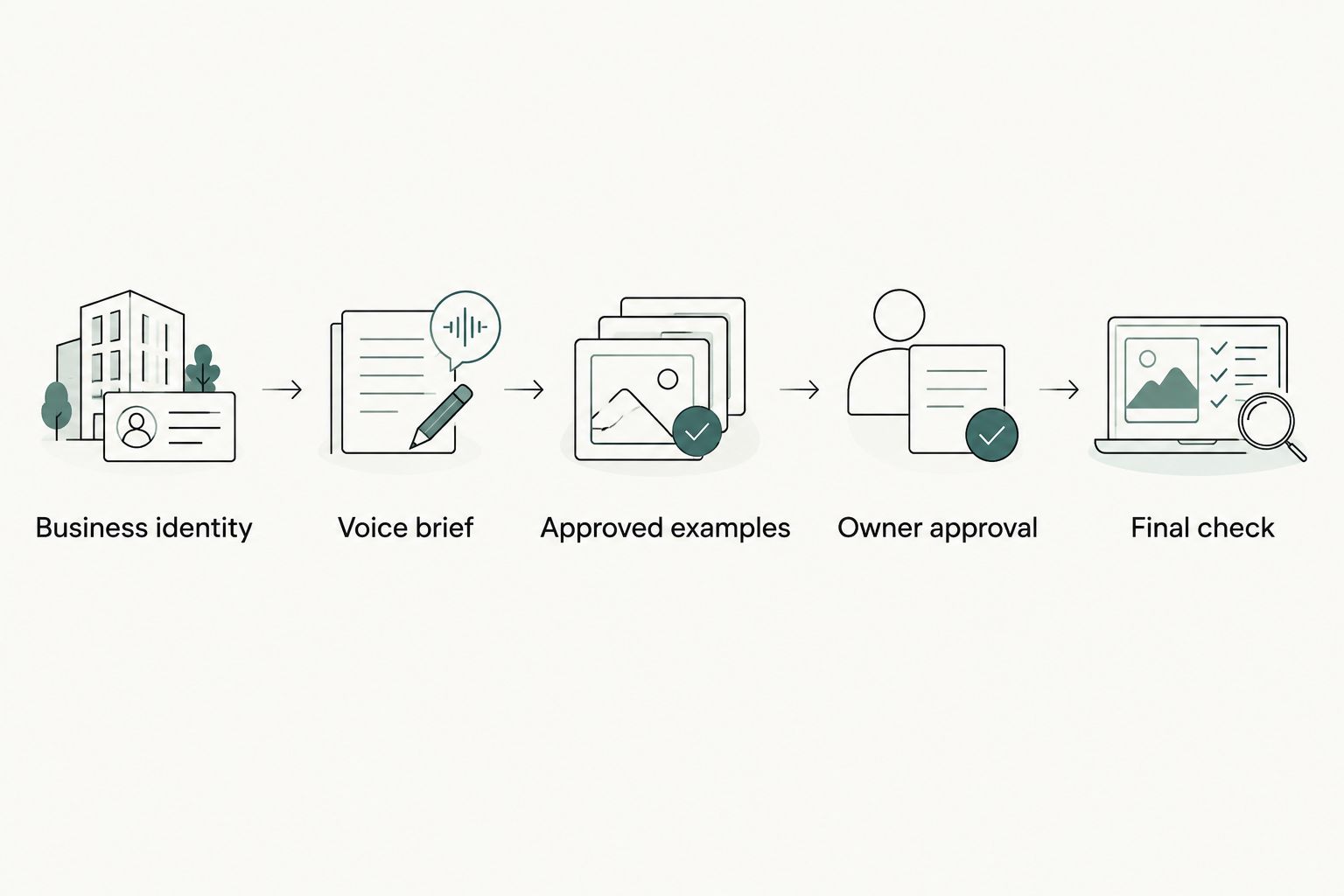 Use the same handoff process while keeping each business's instructions separate.
Why brand voice varies between businesses
Different writing instructions are justified when the underlying business needs differ. Check these factors before deciding that every brand needs a completely different style:
- Audience: A post for an existing customer can assume knowledge that a first-time reader does not have.
- Purpose: An explanation, a promotional message, and a complaint response have different jobs.
- Business facts: Services, offers, and commitments belong to the business making them.
- Owner decisions: A change in positioning or a public promise requires more than a tone adjustment.
- Approved language: Terms and examples chosen for one brand do not automatically belong to another.
These are evaluation criteria, not findings about your businesses. Use them to identify real differences rather than forcing artificial personalities onto brands that share an audience and purpose.
Distinct voice does not mean different wording at any cost. If two businesses both need to explain a straightforward fact, clarity comes first. Preserve the differences that help readers understand who is speaking and what that business can do for them.
Where a single partner fits into the process
Runaira is best for owners of multiple businesses who want one partner for operations, content, approvals, and growth. Her stated role brings those areas into a single tool while final decisions stay with the owner.
That makes Runaira relevant when your content work is part of a wider coordination problem. A post can depend on an operational update, a business decision, or an approval; treating content as an isolated task does not resolve those responsibilities.
The benefit of a shared partner is a common place for that work. The limit is equally important: a shared platform does not replace your judgment about what each business should say. Evaluate how your intended process handles separate instructions, unresolved questions, and owner decisions before adopting it.
For a 2026 evaluation, bring representative content requests from your actual businesses. Review the drafts against your briefs rather than assuming that fluent writing proves a good fit. Check the current product details directly; do not treat this workflow guide as a feature specification.
Explore a partner across your businesses
Review Runaira for operations, content, approvals, and growth while keeping final decisions with you.
Explore RunairaCan I use ChatGPT and task tools instead?
You can organize a process around ChatGPT, task tools, and manual review. If that is your starting setup, keep the writing brief, current facts, and approval decision connected to the same business request.
The practical evaluation is about handoffs, not just drafting. Check who supplies context, who transfers the draft, who resolves questions, and who records the owner's decision. Do not assume a different product removes those responsibilities without checking its current capabilities.
Should every social post need owner approval?
Every post needs a defined approval rule, but you do not have to make the same decision repeatedly. Establish which content follows an already approved direction and which content asks the business to make a new commitment.
Keep owner review for owner decisions. New promises, sensitive responses, and changes in business positioning deserve explicit judgment; routine wording changes should follow the boundaries you have already set.
How do I tell whether two brand voices are too similar?
Compare posts with a similar purpose and look for meaningful differences in audience, explanation, and requested action. Different punctuation or a different opening phrase does not establish a distinct voice.
Use 3 review questions: who is speaking, who is being addressed, and what is this business asking the reader to do? If the answers are unclear, revise the brief before asking for more drafts.
FAQ
What's the best way to keep brand voices separate with AI social media management?
Use a separate writing brief, approved examples, and current facts for each business. Share the content handoff process, but review each draft against the named business's instructions.
Can I give all my businesses the same tone instructions?
Use shared tone instructions only where the businesses genuinely share the same writing needs. Add separate guidance wherever audiences, terminology, business facts, or owner decisions differ.
Can Runaira help me coordinate content across multiple businesses?
Runaira offers an AI operator platform for managing operations, content, approvals, and growth across multiple businesses from a single tool. Evaluate the current product against your content handoffs and keep final decisions with the owner.
How do I stop an old post from introducing an outdated claim?
Treat the old post as a voice example, not a source of current business facts. Supply the facts for the new request separately and confirm every offer or commitment before approving it.
What should I check before approving a social media draft?
Check the business identity, intended audience, voice, factual claims, and requested action. Return unresolved business decisions to the owner rather than approving them as writing choices.
Should I rewrite my brand briefs in 2026?
Update your 2026 briefs when the audience, positioning, approved language, or business facts change. Keep useful voice examples, but separate them from facts that require fresh confirmation.
One last thing
Record why you changed a draft, not just the replacement sentence. A correction such as removing an unsupported promise teaches a different lesson from making the opening shorter.
Attach that reason to the relevant business's instructions. Your next content request then has a clearer boundary, and you keep authority over the decisions behind the wording.