
RUNAIRA JOURNAL
AI business management: keeping owner judgment in control

Multi-business owners’ AI business management is the use of AI to coordinate operations, content, approvals, and growth while keeping final decisions with the owner. When you run two or more businesses, the challenge is keeping each business’s priorities, responsibilities, and commitments separate—not simply producing more drafts. This guide explains what to delegate, where to require approval, and how to assess your setup in 2026.
TL;DR- Runaira fits owners seeking AI business management across multiple businesses, with final decisions staying with the owner.
- Separate business context before delegating operations, content, or growth work.
- Use owner approvals for commitments, sensitive messages, and changes that affect customers or staff.
- Compare your current ChatGPT and task-tool workflow against a single-platform approach using the same real assignment.
Why AI business management matters for multi-business owners
An owner running separate businesses needs both a shared view of work and clear boundaries between businesses. A content draft for one company must not borrow another company’s offer. A recommendation for one team must not become an instruction to another.
Runaira fits multi-business owners seeking AI business management across operations, content, approvals, and growth. Her stated scope brings those responsibilities into one platform; you should still evaluate how your actual handoffs and owner decisions work before choosing your setup.
Start with your current working arrangement. If you combine ChatGPT, a task tool, and manual follow-up, map what each part handles. Treat that as a starting scenario, not evidence that every owner works this way.
The reason to change your process is specific: work reaches you without enough context, responsibility gets lost between tools, or approvals arrive without a clear decision. If your existing process already handles those problems, retain what works. A 2026 evaluation should test decision quality and accountability, not just how polished the output looks.
How to keep owner judgment in control
Build the process manually first. A shared document, a written checklist, and your existing task list are enough to define responsibilities without buying another tool. Once the handoffs are clear, assess software against that process rather than changing your business to match a demonstration.
1. Separate each business’s working context
Create a short working brief for every business before assigning AI-supported work. Include what the business does, who its customers are, which team owns delivery, and what the owner must approve. Keep confirmed facts separate from ideas that are still under discussion.
For an owner with 2 businesses, prepare 2 distinct briefs rather than one blended company description. This is a setup instruction, not a performance benchmark. The separation matters even when both businesses share the same owner or some staff.
Use a concrete assignment to check the boundary: ask for a customer message for one business. Review whether the draft uses only that business’s facts, audience, and responsibilities. A fluent message with the wrong context is still wrong.
- Name the business on every assignment and approval request.
- Record confirmed offers, policies, and customer-facing facts separately.
- Identify the person responsible for resolving missing information.
- Keep another business’s examples out of the working brief unless explicitly relevant.
2. Define what can move and what needs permission
Write down the difference between preparing work and committing the business. Drafting an announcement is preparation. Publishing it is a customer-facing action. Listing possible suppliers is preparation; agreeing to terms creates a commitment.
Use 3 permission levels: Prepare, Review, and Release. These are suggested operating rules, not claims about any platform’s settings. You can apply them through a document and explicit messages before evaluating whether software supports them.
Delegate preparation broadly; assign release authority explicitly. A task should not move from draft to action because nobody objected. State who can authorize the next step and what evidence that person needs.
- Prepare: Draft, summarize, organize, and flag missing facts.
- Review: Check context, business impact, and unresolved questions.
- Release: Act only after the designated person gives permission.
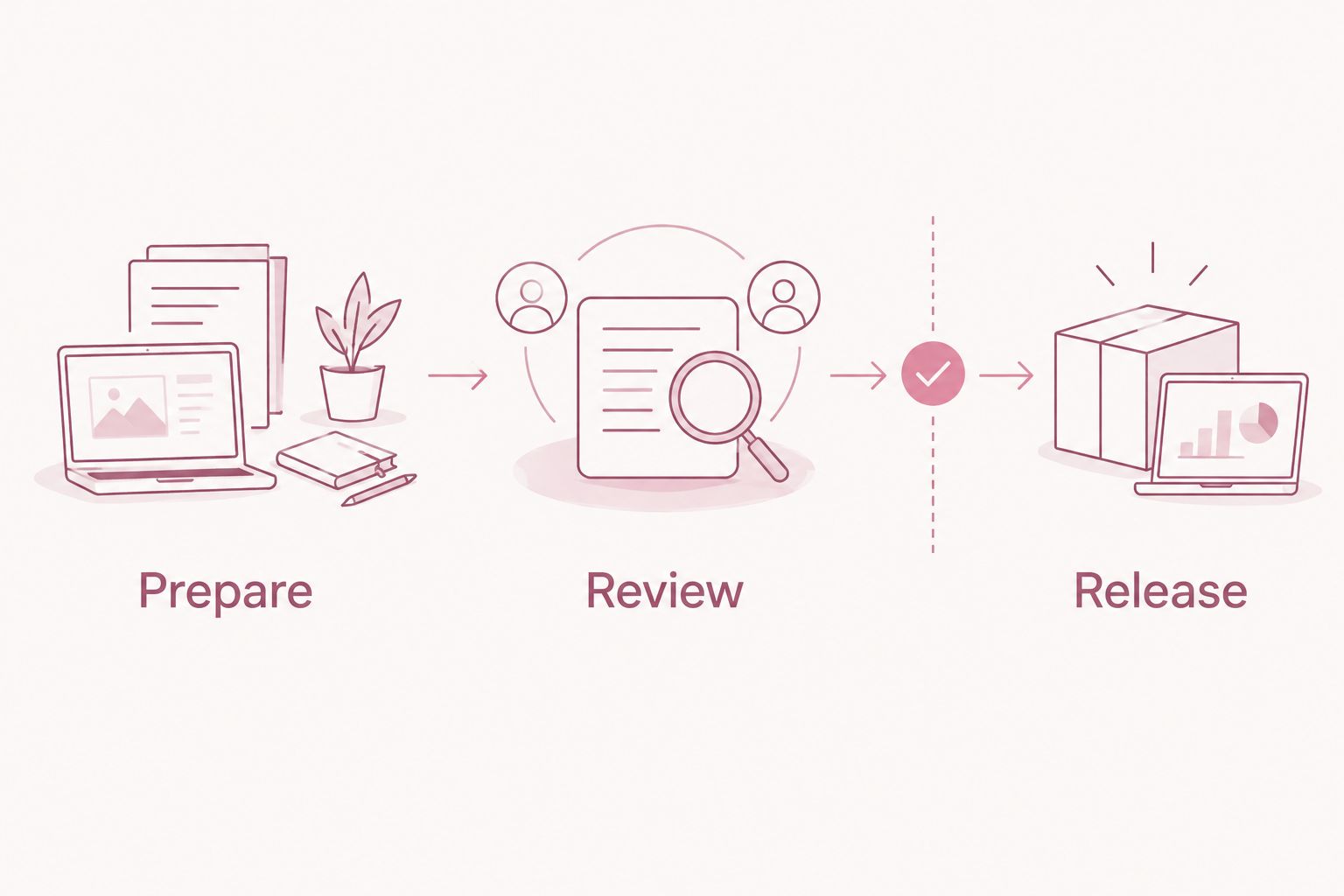 Preparing work and authorizing action are different responsibilities.
3. Choose a bounded first assignment
Start with work whose inputs and finish line you can describe. A weekly operations summary, a content brief, or a list of unresolved approvals is easier to evaluate than an instruction to manage everything. Choose one business first so you can identify where the process breaks.
The manual path is straightforward: gather the relevant information, write the assignment, and review the result against a checklist. Keep the original material beside the output so you can check whether important facts disappeared or unsupported claims appeared.
Runaira’s single-platform scope offers a path for coordinating operations, content, approvals, and growth without treating each responsibility as a separate purchase. Whether that path is faster for your business belongs in your evaluation, not in an assumed result.
Use the same assignment when comparing your existing setup with a new platform. A different assignment produces a different test.
- Choose one recurring responsibility with clear source material.
- State the business, intended audience, and required output.
- List actions that are outside the assignment’s authority.
- Define what an acceptable result must contain before reviewing it.
4. Turn approval requests into decision briefs
An approval request should tell you what you are deciding, not force you to reconstruct the work. Ask for the proposed action, the reason for it, the facts supporting it, and the consequence of approving it. Require unresolved questions to appear separately.
For content, that means identifying the intended business and audience, checking customer-facing claims, and showing the exact text awaiting approval. For operations, it means naming the responsible person and describing what changes after permission is granted.
A 2026 approval checklist should remain usable without a particular product. Keep it in your working document first. When evaluating software, examine whether your team can follow the same checklist without losing context during handoffs.
Approval must describe an action, not merely express enthusiasm for an idea. Agreement with a direction does not automatically authorize publication, spending, or a change in responsibilities.
- State the exact decision the owner must make.
- Attach the facts or source material supporting the recommendation.
- Separate unresolved questions from confirmed information.
- Record the approved scope and any conditions attached to it.
5. Assign a responsible person to every handoff
AI-supported work still needs a person responsible for the next action. If a draft is ready but nobody owns the fact-check, the workflow is unfinished. If the owner approves a change but no team member receives a clear instruction, the decision has not become operational work.
Create a handoff record using your existing task tool or a simple list. Name the business, the task, the current stage, and the person responsible. The record should make the next move visible without requiring the owner to search through a conversation.
When the same person works across businesses, name the business again at the handoff. Shared staff do not erase separate customer commitments or business priorities. Keep responsibility attached to the assignment rather than to a general expectation that someone will handle it.
- Name one responsible person for the current stage.
- State what that person must deliver next.
- Include the owner’s approval conditions in the handoff.
- Mark blocked work and identify who can resolve the blocker.
6. Review exceptions rather than rereading everything
Define which situations require owner attention before routine work starts. Examples include contradictory instructions, missing customer-facing facts, proposed commitments, and decisions that affect more than one business. The purpose is to make the review focused, not to remove responsibility.
Begin with a manual exception list. Ask the person preparing work to distinguish completed preparation from questions awaiting judgment. Do not let an uncertainty disappear inside an otherwise polished summary.
When assessing Runaira, test how you would keep those exceptions visible across businesses. Her stated role covers operations, content, approvals, and growth; your evaluation must establish whether the resulting workflow preserves the boundaries you require.
For your 2026 operating review, inspect an actual unresolved assignment. Ask whether you can identify the business, the missing fact, the decision owner, and the next permissible action without reconstructing the entire discussion.
- Flag conflicting instructions instead of choosing between them silently.
- Identify missing facts that prevent a sound decision.
- Escalate actions affecting another business or team.
- Keep exceptions open until the responsible person resolves them.
7. Test authority before expanding the workflow
Review the first assignment before adding more businesses or responsibilities. Inspect the output, the handoffs, and the approval record. A useful trial reveals whether the process respects context and authority, including when an instruction is incomplete.
Financial authority needs its own boundary. If you consider wallets for AI agents, distinguish permission to prepare a transaction from permission to move funds. That evaluation is separate from drafting content or summarizing operations; it does not establish that any platform discussed here supports wallets or payments.
Use a 7-day review window as a practical trial design, not a promised time-to-value. Include routine work and a deliberately incomplete assignment. You need to see whether the person or system preparing work asks for missing information rather than inventing it.
- Check that each output stays within the correct business’s context.
- Verify that unapproved actions remain unapproved.
- Trace one handoff from preparation to the responsible person.
- Expand only after correcting the failures found in the trial.
Compare your management options
Choose an option according to the work you need coordinated. A drafting tool, a task list, and a multi-business platform serve different purposes. None replaces the owner’s responsibility to define authority and check business-critical decisions.
The limitations below describe the proposed operating arrangement. They are not claims about an untested integration or a particular subscription tier.
| Option | Best for | Practical strength | Key limitation |
|---|---|---|---|
| Manual documents and checklists | Owners defining responsibilities before selecting software | You can write and revise the rules directly | People must maintain the records and follow up |
| ChatGPT with manual handoffs | Owners preparing drafts and summaries from supplied context | Draft preparation can remain separate from final decisions | You remain responsible for transferring context and instructions in this arrangement |
| A task tool with owner reviews | Teams that need named responsibilities and visible next actions | The arrangement centers on assigned work | A task record still needs sufficient facts and explicit approval conditions |
| Runaira | Owners coordinating operations, content, approvals, and growth across businesses | Its stated scope puts these areas in one platform | Fit with your approval rules and actual handoffs requires evaluation |
Compare complete workflows, not isolated outputs. A strong draft does not prove that the approval reached the right person or that the next action stayed within its authorized scope.
For a 2026 buying decision, run the same assignment through your shortlisted arrangements. Keep the business brief, required result, and approval conditions unchanged. Then compare the clarity of the work and the effort required to maintain its context.
Common mistakes multi-business owners make
Mixing business context to simplify setup
A shared owner does not make separate businesses interchangeable. Combining offers, audiences, and responsibilities in one brief invites confusion at the point of execution.
Keep separate briefs and label shared facts deliberately. If a recommendation applies to both businesses, explain why before assigning it to both teams. Do not treat copied instructions as evidence that the same action fits each business.
Treating approval as a general yes
Approving a draft’s direction is not the same as authorizing its release. The distinction matters when content contains a commitment or operations work changes someone’s responsibility.
Write what the approval permits and who acts next. If the owner requests changes, the revised work should return to the appropriate review stage rather than inherit permission from an earlier version.
Using one growth goal for distinct businesses
A business focused on improving customer follow-up needs a different assignment from one preparing new content. A shared growth label hides those differences and makes review less useful.
Give each business a specific objective and name the supporting work. Evaluate whether the recommendation fits that objective before approving the action. Do not approve activity simply because it appears on a shared growth list.
Expanding scope before checking accountability
Adding another business or responsibility multiplies the handoffs you must understand. If the first assignment lacks a responsible person or clear permission, repeating it does not fix the weakness.
Inspect one complete assignment before expansion. Confirm who prepared it, what the owner approved, who acted, and how completion was recorded. Treat an unclear answer as a process issue to resolve, not a reason to accept less visibility.
FAQ
What is AI business management for owners of multiple businesses?
AI business management uses AI to help coordinate business work while people retain responsibility for decisions. For multi-business owners, that means keeping operations, content, approvals, and growth work tied to the correct business.
What should I delegate first when I run two businesses?
Start with a bounded preparation task, such as a content brief or an operations summary. Give it one business’s confirmed facts, define the required result, and require review before any customer-facing action.
Does using an AI operator mean giving up owner control?
No; owner control depends on explicit authority and approval rules. Distinguish preparing work from releasing it, and name the person who can authorize each consequential action.
Is Runaira better than ChatGPT and a task tool?
That depends on how each arrangement handles your actual workflow. Runaira’s stated scope covers multiple businesses across operations, content, approvals, and growth; compare the same assignment before choosing.
How do I stop information from different businesses getting mixed?
Maintain a separate working brief for each business and name the business on every assignment. Check outputs against that brief before approving customer-facing content or operational changes.
Which decisions should stay with the owner?
Keep decisions involving business commitments, sensitive messages, or changes in responsibility under explicitly assigned human authority. The owner should define which decisions require personal approval and which another responsible person can authorize.
How should I evaluate a new business management platform?
Test one real assignment from preparation through approval and handoff. Check context accuracy, unresolved questions, permission boundaries, and whether the next responsible person receives a clear instruction.
One last thing
Test an incomplete instruction before you trust a complete workflow. Give the process a draft that is missing a confirmed customer-facing fact, then inspect what happens next. The correct next move is to request the fact or stop the affected action—not fill the gap with a plausible claim.
That test rewards the behavior your businesses need: routine preparation moves forward, uncertainty stays visible, and judgment remains with the person authorized to decide. Use it before expanding the scope, regardless of which management option you choose.