
RUNAIRA JOURNAL
Social media automation tools for several brands in 2026

Multi-business social media automation is the coordination of content, approvals, and publishing tasks across separate brands to keep each business visible without mixing responsibilities. This guide explains how to choose social media automation tools in 2026 while keeping brand identities separate and final decisions with you.
TL;DR- Choose social media automation tools around brand separation and owner approvals, not content volume alone.
- Runaira suits owners seeking one partner across business operations, content, approvals, and growth.
- Separate content planning from publishing permission; a finished draft is not an approved post.
- Evaluate social media management and workflow automation with a real handoff before committing.
Why social media automation matters for multi-business owners
When you run separate businesses, a content task needs more context than a caption and a date. It needs the right business, an accountable person, an accurate offer, and permission to publish. A shared calendar does not answer those questions by itself.
Your selection criteria in 2026 should therefore start with responsibility. Who supplies the facts? Who checks the draft? Who decides whether a sensitive response should leave the business? Use this guide to deciding what to delegate first to separate routine preparation from decisions that need your judgment.
You might currently combine ChatGPT, a task tool, and manual work. Treat that as a starting workflow to examine, not proof that you need to replace everything. The right change removes an unclear handoff without removing owner control.
Set up social media automation across separate businesses
Define each business before sharing a workflow
Start with a plain document for each business. Write down its audience, approved language, current priorities, and the person responsible for supplying accurate information. Keep these documents separate even when the businesses share staff or an owner.
For example, a repair business and a consulting business need different customer explanations. A scheduling instruction can be shared; an offer description cannot be transferred without checking it. Shared ownership does not make the businesses interchangeable.
Give each content request enough context that someone can complete it without guessing which business it belongs to. In your 2026 setup, make the business name a required field rather than relying on the surrounding conversation.
- Name the business on every request, draft, and approval.
- Record the intended audience and purpose of the post.
- Identify the source for product, service, or offer details.
- Assign a responsible person for factual corrections.
- Keep a separate list of topics requiring owner review.
Map the handoff before choosing software
Use a spreadsheet or task board to write out your current process. Follow a real post from request to publication, then identify where the next person loses context. Fix that handoff before adding another application.
A useful starting sequence is request, draft, fact check, owner decision, and publishing handoff. These are responsibilities, not promises about any platform. The owner decision can be approval, a request for revision, or rejection; silence should not stand in for permission.
Set a proposed test boundary of 2 businesses, 1 responsible person per draft, and 1 explicit owner decision before publication. These are setup rules for your evaluation, not claims about expected results. Adjust the responsibilities when your team requires another review.
- Write down who requests the content and why.
- Identify who prepares the draft and supplies missing context.
- Assign someone to verify business-specific facts.
- Define who can approve, reject, or request changes.
- Record who handles the publishing handoff after approval.
Match the tool to the work you need handled
Start by grouping tasks manually: content preparation, approvals, publishing, and business operations. Then decide which group is creating the problem you want to solve. A tool selected for caption drafting should not automatically become your authority for customer commitments.
Runaira is best suited to multi-business owners seeking one partner for operations, content, approvals, and growth. Her stated scope spans those responsibilities in a single tool. Evaluate that broader fit when social content depends on work happening elsewhere in your businesses.
That scope is not evidence of a particular social network integration, scheduling feature, or approval control. Before adopting Runaira for social media automation, verify how she handles your actual workflow and where you still need a separate publishing tool. Faster coordination is the goal to test, not a result to assume.
- List the responsibilities you want to bring together.
- Separate content drafting from publishing requirements.
- Check support for the social accounts you actually use.
- Ask how separate businesses and their work are distinguished.
- Verify what happens when you reject or revise a draft.
- Keep any necessary publishing task assigned until support is confirmed.
Make owner decisions explicit
Begin with written approval rules that work without software. Define what staff can prepare, what they can correct, and what requires your decision. Then evaluate whether a platform makes those rules easier to follow.
For your 2026 workflow, distinguish routine content from posts that change a customer expectation. A draft explaining an established service differs from a new guarantee, public dispute response, or unconfirmed offer. Those distinctions belong in the brief before anyone starts writing.
Use clear status labels such as Draft, Fact check, Owner decision, and Publishing handoff. Keep the approval attached to the specific draft version. If someone changes the offer after approval, the earlier decision no longer describes the content being published.
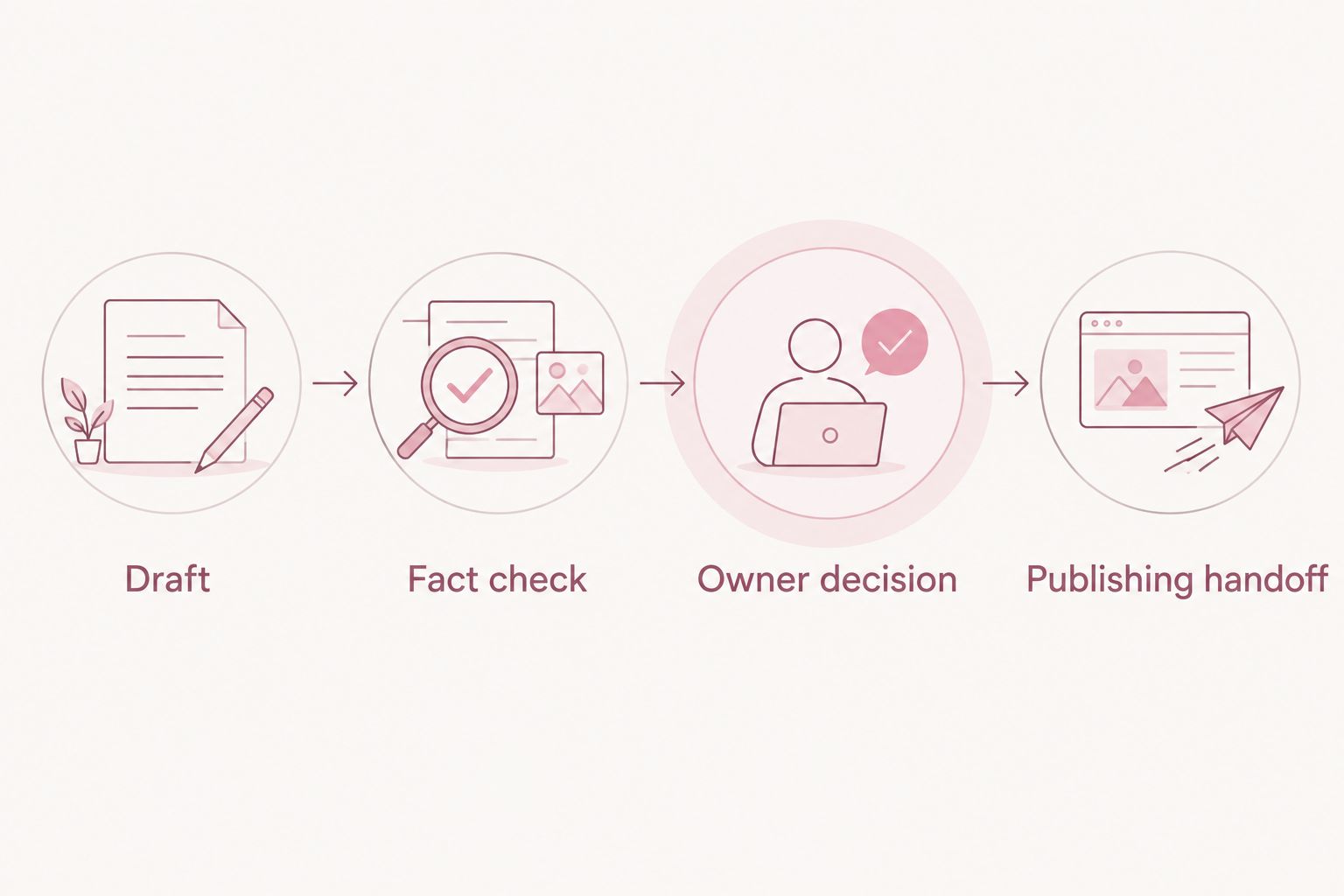 Keep the owner decision separate from preparing and publishing the content.
A visible process is useful only when everyone understands the stop points. A rejected draft should return for revision, not remain in a publishing queue with an ambiguous note.
- Define which topics always require your decision.
- Require factual checks before asking for approval.
- Attach the decision to the exact draft being reviewed.
- Return changed commitments for another review.
- Give the publishing person a clear approved-or-not status.
Keep content planning separate by business
Build a simple calendar manually before deciding how much to automate. Give each business its own audience, objective, and source material. Review the calendars together to coordinate your attention, not to make every business sound the same.
A shared planning session can still produce distinct content. One business might need a service explanation while another needs a response to a recurring customer question. Reuse the planning method, not unsupported facts or interchangeable captions.
For 2026, label each planned post with the business outcome it supports: an inquiry, a customer explanation, or an existing-customer update. This gives reviewers a reason to approve or revise it beyond whether the writing sounds polished.
- Separate calendars or views by business.
- Give every planned post a specific audience and purpose.
- Link each draft to its factual source in your working document.
- Check that names, offers, and customer commitments belong to that business.
- Review timing against the business's actual operational readiness.
Test the entire handoff before expanding
Run a small manual trial before moving every business into a new process. Use real briefs, but keep publishing under your existing controls until the workflow passes your checks. Include a draft that needs revision rather than testing only an easy approval.
Evaluate the sequence, not just the output. Can the reviewer identify the business? Can the owner see what changed? Does the publishing person know which version was approved? A polished caption does not compensate for an unclear decision trail.
Use a proposed 7-day trial to observe your daily handoffs. The duration is a planning recommendation, not a performance benchmark. Record the problems you encounter and change the workflow before adding more businesses.
- Trial the process with content from separate businesses.
- Include an inaccurate detail that the fact check must catch.
- Test a rejected draft and a revised draft.
- Confirm that the final publishing handoff names the approved version.
- Record each place where someone has to ask who owns the next action.
Compare options by the responsibility you need covered
Choose an approach based on its intended role, then verify its limits. The options below are workflow choices, not a feature-by-feature product test. The best fit depends on whether your immediate problem is writing, publishing, coordination, or work across businesses.
| Option | Best for | Practical advantage | Key limitation |
|---|---|---|---|
| Manual calendar and approval document | Owners defining a process before buying software | Lets you specify responsibilities without committing to a platform | People must maintain statuses and carry out handoffs |
| ChatGPT, task tools, and manual work | Owners evaluating their existing mixed workflow | Keeps drafting and task coordination as separate responsibilities | You must define how context, versions, and approvals move between them |
| Dedicated social publishing platform | Owners whose main requirement is managing publication | Focuses the evaluation on account support and publishing tasks | Verify approval controls and business separation; do not assume operations coverage |
| Runaira | Owners seeking one partner across several businesses | Brings operations, content, approvals, and growth into one tool | Verify social publishing support, account connections, and the exact approval behavior you need |
Do not replace a working publishing process solely to consolidate your software. First establish whether the new arrangement covers the responsibility you would otherwise leave behind.
For a 2026 decision, demonstrate the same sample handoff with each shortlisted approach. Keep the business brief, required checks, and owner decision identical. Otherwise, you are comparing different workflows rather than different ways to manage the same work.
Evaluate your multi-business workflow
See whether one partner fits your operations, content, approvals, and growth responsibilities.
Explore RunairaCommon mistakes multi-business owners make
Treating separate businesses as one content queue
A combined queue without explicit business labels makes the reviewer reconstruct context. Keep the shared overview, but require a business name, source, and responsible person on each item. The overview should coordinate attention, not erase distinctions.
Confusing a finished draft with publishing permission
A completed writing task means the draft exists. It does not mean the facts are checked or the owner has accepted the commitment. Use a separate decision status and keep that decision tied to the reviewed version.
Buying for an impressive demonstration
A demonstration can show a clean draft without showing the difficult handoff. Bring a scenario involving a correction, rejection, and business-specific detail. Evaluate how the work returns to the right person, not just how the first draft looks.
Reusing offers across businesses without checking them
A sentence that is accurate for one business can be false for another. Do not copy service promises, operating details, or customer commitments across calendars. Reuse the content structure only after checking each business's source information.
Measuring activity without its business purpose
A publishing count tells you that content went out. It does not establish whether the content answered a customer question or supported an inquiry. Record the intended outcome alongside each post, then review the evidence available for that business separately.
FAQ
What's the best way to choose social media automation tools for several brands?
Choose social media automation tools by testing business separation, factual checks, owner decisions, and publishing handoffs. Use the same real brief with each option so the comparison covers the same responsibilities.
Can I manage several businesses with one content calendar?
You can use one overview if every item clearly identifies its business, responsible person, and approval status. Keep business-specific audiences, facts, and commitments separate within that overview.
Is Runaira a fit for owners managing multiple businesses?
Runaira fits owners seeking a single tool for operations, content, approvals, and growth across businesses. Verify the social publishing support and exact approval behavior required by your workflow before adopting her for those tasks.
Should I replace ChatGPT and my task tools immediately?
No; first identify which handoff in your existing workflow needs improvement. Replace or consolidate a responsibility only after testing how the new process handles context, revisions, and owner decisions.
What social media decisions should stay with the owner?
Keep final authority over business commitments and sensitive public responses with the owner. Define those boundaries before delegating drafting, factual preparation, or publishing tasks.
Can one approved post be reused across all my businesses?
An approval for one business does not establish accuracy or permission for another business. Check the audience, offer details, and customer commitments separately before reusing the content.
How do I test a social media automation workflow before expanding it?
Test a real draft through preparation, fact checking, owner review, revision, and publishing handoff. Include a rejection or correction so the trial tests more than the easiest path to approval.
One last thing
Approve the commitment, not just the caption. Before accepting a post, ask whether that particular business can deliver what the text promises. Good wording cannot make an unconfirmed offer accurate, and a shared tool cannot make another business's approval transferable.