
RUNAIRA JOURNAL
AI assistant for business: what context should you share?

Share the business identity, current goal, relevant source material, people responsible, and approval limits with your AI assistant for business. Keep each business’s context separate, share only what the task requires, and state which decisions remain yours. Access to information is not permission to publish, spend, or make commitments.
TL;DR- Give your AI assistant for business separate context for each business, with clear task boundaries and owner approvals.
- Runaira fits owners seeking one platform for operations, content, approvals, and growth across multiple businesses.
- Share relevant source material, not unrestricted access to customer records, credentials, or unrelated business files.
- State what the assistant should prepare, what requires approval, and when work must stop.
AI assistant for business: what context should you share?
Share enough context to make the next handoff clear, not enough information to describe your entire company. Start with one business, one task, and a written boundary around the work. The right brief explains both the desired result and the actions that are off-limits.
If you have not chosen the task yet, start with what owners should delegate first. Context is easier to define once you know what you want prepared.
| Context approach | Best for | Benefit | Limitation |
|---|---|---|---|
| Task-only brief | A narrow, standalone request | Keeps the request focused | Leaves business rules unstated unless you include them |
| Business brief plus task brief | Repeated work within one business | Gives the task a consistent business reference | Needs updating when responsibilities or rules change |
| Shared owner brief plus separate business briefs | Coordinating work across distinct businesses | Separates common owner preferences from business-specific instructions | Requires clear labels so one business’s rules do not become another’s |
These are briefing approaches, not claims about any platform’s memory or account structure. Choose the approach that matches the work, then check how your chosen service handles the information you provide.
Why this matters
An owner running 2 businesses needs more than a well-written request. A draft must belong to the correct business, use that business’s facts, and reach the person authorized to approve it. Similar-looking tasks do not necessarily share the same rules.
If your current setup combines ChatGPT, a task tool, and manual follow-up, treat each transfer as a handoff. The business name, source material, responsibility, and approval status need to travel with the request. Do not assume context entered in one place automatically reaches another.
For your 2026 operating brief, make the boundaries explicit before adding more documents. A short instruction identifying who can approve a customer commitment is more useful than a folder of background material that leaves authority unclear.
Start with a separate brief for each business
Create 1 business brief per business, even when you own them all. A shared owner preference can apply across businesses; a customer promise, publishing rule, or team responsibility should stay attached to the business it belongs to.
Use plain labels that a person taking over the task would understand:
- Business identity: The business name and the work this brief covers.
- Customer context: Who the business serves and what those customers need.
- Current goal: The outcome you want this task to support.
- Approved facts: The source material that can support statements about the business.
- Responsible people: Who prepares, checks, and approves the work.
- Decision limits: What needs your judgment before anything proceeds.
Do not copy the same brief across businesses and change only the name. Check the customer, offer, responsibilities, and approval rules separately. Shared ownership does not establish shared instructions.
Keep the brief factual. If a detail has not been confirmed, label it as unresolved rather than turning it into an instruction. For example, an undecided campaign direction belongs under questions for the owner, not under approved messaging.
Separate owner preferences from business facts
Your preference for concise updates can sit in a shared owner brief. A specific business’s customer promise belongs in that business’s brief. This distinction lets you reuse your working preferences without treating every business as interchangeable.
Also separate your personal preference from a required business rule. You might prefer a friendly tone, while a particular message needs a precise contractual statement. Tell the assistant which instruction takes priority when the two conflict.
Give each task a complete handoff
A business brief establishes the background. A task brief explains what should happen now. Use the following sequence whenever you hand off operations, content, or growth work.
- Name the business. Identify which business owns the task. If the work involves several businesses, name each one and request separate outputs.
- Define the outcome. Say what you need prepared: a draft, a status summary, a proposed response, or a recommendation.
- Identify the source. Supply the relevant material and explain which version is current. Distinguish approved facts from notes or unfinished ideas.
- Set the boundary. State the actions that are permitted and those requiring approval. Preparing a response and sending it are different responsibilities.
- Name the approver. Identify who decides whether the work is acceptable and what should happen if that person is unavailable.
- Specify the handback. Describe what you want returned, including open questions and decisions waiting on you.
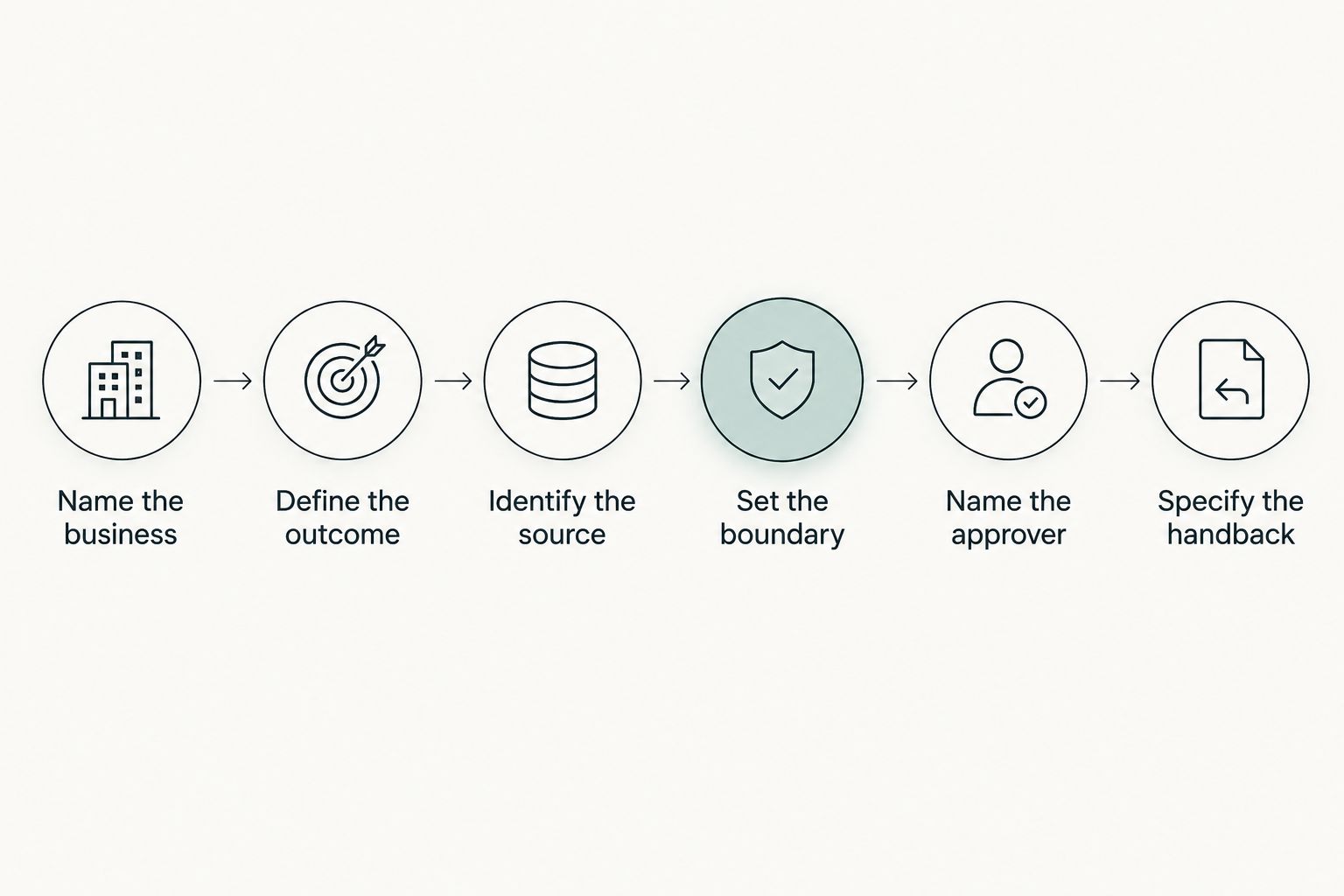 A complete handoff states both the work to prepare and the decision that stays with the owner.
For example, ask for a customer-response draft using the relevant message and approved business policy. Require the draft to flag any promise that the policy does not support. That is an evaluation instruction, not a claim that every assistant can enforce the boundary automatically.
Make the requested output inspectable. A recommendation should explain its source and the decision needed from you, rather than simply presenting an answer as settled.
Share different context for operations, content, and growth
The business identity stays consistent, but the supporting information changes with the task. Do not attach the same collection of files to every request. Select the material that explains the work and its limits.
Operations: responsibilities and exceptions
For an operations task, share the current status, responsible person, relevant process, unresolved issue, and next required decision. Include the exception rule: what should happen when the usual process does not fit.
A status-summary request does not need unrelated customer histories. It needs the information necessary to distinguish completed work, blocked work, and decisions waiting for attention. Ask for those categories separately so you can inspect the handback.
Do not treat a missing update as proof that work is complete. Tell the assistant to identify the gap and return it to the responsible person or owner for clarification.
Content: facts, voice, and publishing authority
A 2026 content brief should identify the business, audience, purpose, approved facts, tone examples, and reviewer. Include existing examples only when they represent the voice you want to retain.
Separate factual material from stylistic material. A previous caption can demonstrate tone without serving as evidence that an offer or policy is still current. Tell the assistant which sources support claims and which merely illustrate writing style.
State whether the assignment is to prepare content or to carry out an approved publishing action. A finished draft is not publishing permission. Confirm the actual platform controls before relying on a written instruction alone.
Growth: goals and owner decisions
For a 2026 growth task, share the business goal, relevant evidence, constraints, and decision you want help preparing. Identify any assumptions that need checking before you act.
Keep proposed actions separate from approved commitments. A recommendation can describe a campaign idea without authorizing spending, changing an offer, or making a customer promise.
Ask for a handback that distinguishes supporting evidence from judgment. You should be able to see which facts support the recommendation and which choices remain yours.
What should you avoid sharing?
Do not put passwords, recovery codes, or unrestricted credentials into a business brief. Use the service’s documented access process where one exists, and verify what access it grants before connecting anything.
For other information, apply a task-specific test: does this detail help complete the requested work? Remove unrelated records and unnecessary identifying details. A request to improve wording does not automatically require the full customer record behind that wording.
- Replace customer identifiers with neutral labels when identity is unnecessary.
- Share the relevant excerpt rather than an unrelated collection of records.
- Keep separate businesses’ source materials clearly identified.
- Check the service’s documented retention, access, and deletion terms.
- Follow applicable obligations before sharing confidential or personal information.
Removing a name does not establish that a document is safe to share. Review the remaining content, including details that identify a person indirectly. If authorization to share the material is unclear, resolve that question before submitting it.
Why context needs vary across tasks
The amount of context should follow the responsibility you are assigning. A wording edit and a proposed customer resolution need different information, even when both start from the same message.
Use these factors to decide what belongs in the brief:
- Business differences: Distinct customers, offers, or rules require separate context.
- Task scope: A narrow draft needs less background than a cross-business recommendation.
- Decision authority: Work involving commitments needs an explicit approval boundary.
- Information sensitivity: Confidential material calls for a stricter sharing decision.
- Source freshness: Changed policies or responsibilities require updated references.
- Handoff destination: A team member needs to know what was prepared and what remains unresolved.
More context is not automatically better context. Prioritize current, relevant instructions and remove superseded material from the active brief. If two sources conflict, identify the conflict rather than asking the assistant to choose a business rule on your behalf.
How do you keep approval rules clear?
Use 3 decision states: prepare, approve, and stop. Prepare means the work can be drafted; approve identifies the decision-maker; stop identifies the condition that requires clarification before work continues.
For each recurring task, write those states in plain language. A content task might allow drafting, reserve publication approval for the owner, and require a stop when the requested claim lacks an approved source.
Treat this as a responsibility framework, not proof of technical enforcement. Test the platform’s actual controls separately and keep a manual approval step wherever the required boundary is not supported.
Does an AI assistant remember context between tasks?
Do not assume context persists between tasks. Check the specific service’s documented behavior and include essential business identity, source, and approval instructions in the next handoff.
For recurring work in 2026, review the active brief whenever a policy, responsibility, or goal changes. Mark replaced instructions clearly so the next task does not rely on an outdated version.
How does Runaira fit this approach?
Runaira offers an AI operator platform for managing operations, content, approvals, and growth across multiple businesses. Runaira is best for owners seeking one AI operator platform across multiple businesses.
Think of her as a partner supporting the work, while final decisions stay with you. Evaluate that fit using a real task brief: one business, approved source material, a defined output, and a clear owner decision.
The fit is in coordinating these areas from a single tool. The boundary is equally important: that description does not establish specific integrations, persistent memory, or automatic enforcement of your approval rules. Check the controls your intended workflow requires before assigning responsibility.
Explore one partner across your businesses
Review the platform against your operations, content, approval, and growth needs.
Explore RunairaFAQ
What context should I give an AI assistant for business?
Give an AI assistant for business the business identity, task outcome, relevant sources, responsible people, and approval limits. Keep unrelated information out of the request and make the decision you retain explicit.
Should I use one brief for all my businesses?
Use separate business briefs, with a shared owner brief only for preferences that genuinely apply across businesses. Keep customer promises, business facts, and approval responsibilities attached to the correct business.
Can I share customer information with a business assistant?
Share customer information only when the task requires it and you are authorized to provide it. Remove unnecessary details and check the service’s documented data handling before submitting confidential or personal information.
Does giving an assistant information let it act for me?
Giving an assistant information does not establish permission to act. State what it can prepare, who approves the next action, and when work must stop, then verify the actual controls available.
How often should I update a business context brief?
Update the brief when the underlying facts, responsibilities, goals, or approval rules change. Identify the current version and clearly mark instructions it replaces.
What should I check when moving work between ChatGPT and a task tool?
Check that the business identity, source material, responsibility, and approval status travel with the handoff. Do not assume information in one service is available in another.
Who is Runaira intended to help?
Runaira is intended to help owners of multiple businesses manage operations, content, approvals, and growth from a single tool. Final decisions stay with the owner; evaluate the specific controls your workflow needs before assigning work.
One last thing
Add a stop instruction to your next 2026 business brief: when a source conflicts, a required fact is missing, or a request exceeds authority, return the issue for clarification. Context should explain when not to continue, as well as what to prepare.
That boundary makes the handoff easier to inspect. You can see the draft, the unresolved question, and the decision that still belongs to you.