
RUNAIRA JOURNAL
AI workflow automation: what happens when a handoff fails?

When a handoff fails in AI workflow automation, the next task either stops, proceeds without the right information, or repeats work that already happened. Your response should depend on what crossed the boundary: an internal draft needs a different recovery decision from a customer message or an approved business commitment. Stop the affected path, establish what actually happened, and keep final decisions with the owner before work resumes.
TL;DR- AI workflow automation needs a clear owner, completion evidence, and a recovery decision at every handoff.
- Runaira fits owners seeking one partner for operations, content, approvals, and growth across separate businesses.
- Check whether an action happened before retrying it; uncertainty is not permission to repeat.
- Keep owner approvals separate from routine task completion, especially when work crosses businesses.
AI workflow automation: what happens when a handoff fails?
A failed handoff breaks the connection between one completed task and the next person's or system's responsibility. A draft can exist without reaching its reviewer. A reviewer can approve one version while another version moves forward. A task can appear unfinished even though its external action already happened.
Treat the handoff as incomplete until you can identify the business, the recipient, the approved work, and the outcome. Your owner approvals guide should define those boundaries before anyone resumes the task.
The following table describes failure situations, not the documented behavior of any particular platform. Use it to choose a recovery action rather than assuming every error needs a retry.
| Handoff situation | Best for: recovery approach | Benefit | Limitation |
|---|---|---|---|
| Work never reached its recipient | Resend after confirming non-delivery | Restores the intended handoff | Repeating without checking can create duplicates |
| Work arrived without enough context | Return for missing information | Keeps the next person from guessing | Adds another review round |
| Approval applies to a different version | Hold for owner confirmation | Preserves the owner's decision boundary | Stops progress until the version is settled |
| An external action has an uncertain outcome | Verify before retrying | Avoids repeating an action blindly | Requires evidence beyond the task status |
| Work reached the wrong business or team | Contain and correct the routing | Restores business separation | Correction does not undo information already shared |
Why this matters when you own separate businesses
The important question is not whether a task moved. It is whether the right task moved for the right business, with the right authority. A shared operating routine should not turn separate businesses into interchangeable work queues.
Consider a proposed promotion for one business and a customer follow-up for another. Both involve content and approval, but their audiences, commitments, and decision owners differ. A handoff that loses the business name leaves the recipient with work they cannot safely interpret.
For your 2026 operating review, examine the gaps between drafting, reviewing, approving, and acting. A completed draft is not a completed approval, and a completed approval is not evidence that the action happened. Record each distinction in language your teams already use.
Recover a failed handoff in 6 steps
Use this sequence as a recovery procedure, not as a claim about built-in software features. The owner remains responsible for deciding what is safe to resume, while the assigned team member gathers evidence and prepares the next action.
1. Pause downstream work
Stop the affected task from advancing while you investigate. If a content approval failed, hold the related publication rather than stopping unrelated work across every business. Keep the pause tied to the uncertain handoff.
Give the paused task a named person responsible for resolving it. A general instruction to investigate leaves the next handoff undefined. State who checks the outcome and who decides whether work resumes.
2. Check what actually happened
Look for evidence at the destination, not just the sending side. Check the received message, the visible publication, the accepted task, or the recipient's confirmation, depending on the work involved. An attempted action and a completed action are different facts.
Separate confirmed information from unanswered questions. If you cannot establish whether an external action happened, leave its outcome unresolved. Do not turn a missing confirmation into an assumption that nothing happened.
3. Restore the business context
Attach the business name, intended recipient, current work, and reason for the handoff. If someone needs to make a decision, include the decision requested and the consequence of acting. Remove unrelated material from other businesses.
The receiving person should not need to reconstruct the task from scattered conversations. Give them enough context to understand the assignment without asking them to infer which business, customer, or campaign you mean.
4. Confirm the approval
Check that the approval belongs to this business, this action, and this version of the work. A general agreement with a campaign idea does not establish approval for every later message or commitment. Ask the owner to resolve any mismatch.
If the work changed after approval, identify the change before resubmitting it. The useful question is whether the change affects the owner's decision, not whether the draft still looks broadly similar.
5. Choose the recovery action
Choose between resending, revising, canceling, or escalating based on the evidence. Resend work only after establishing that the intended action did not happen. Revise when the handoff lacks information; escalate when the decision exceeds the assigned person's authority.
Record the choice and its reason beside the task. This gives the next person a usable instruction rather than an unexplained status change. It also distinguishes a deliberate cancellation from an unresolved failure.
6. Close with evidence
Confirm that the intended recipient accepted the handoff or that the intended action completed. Then update the task with its actual outcome and any remaining responsibility. A recovery is not finished merely because someone tried again.
Before closing, check for duplicate work created during the interruption. Tell the relevant people which version or task remains active. That final clarification keeps an old attempt from becoming a new source of confusion.
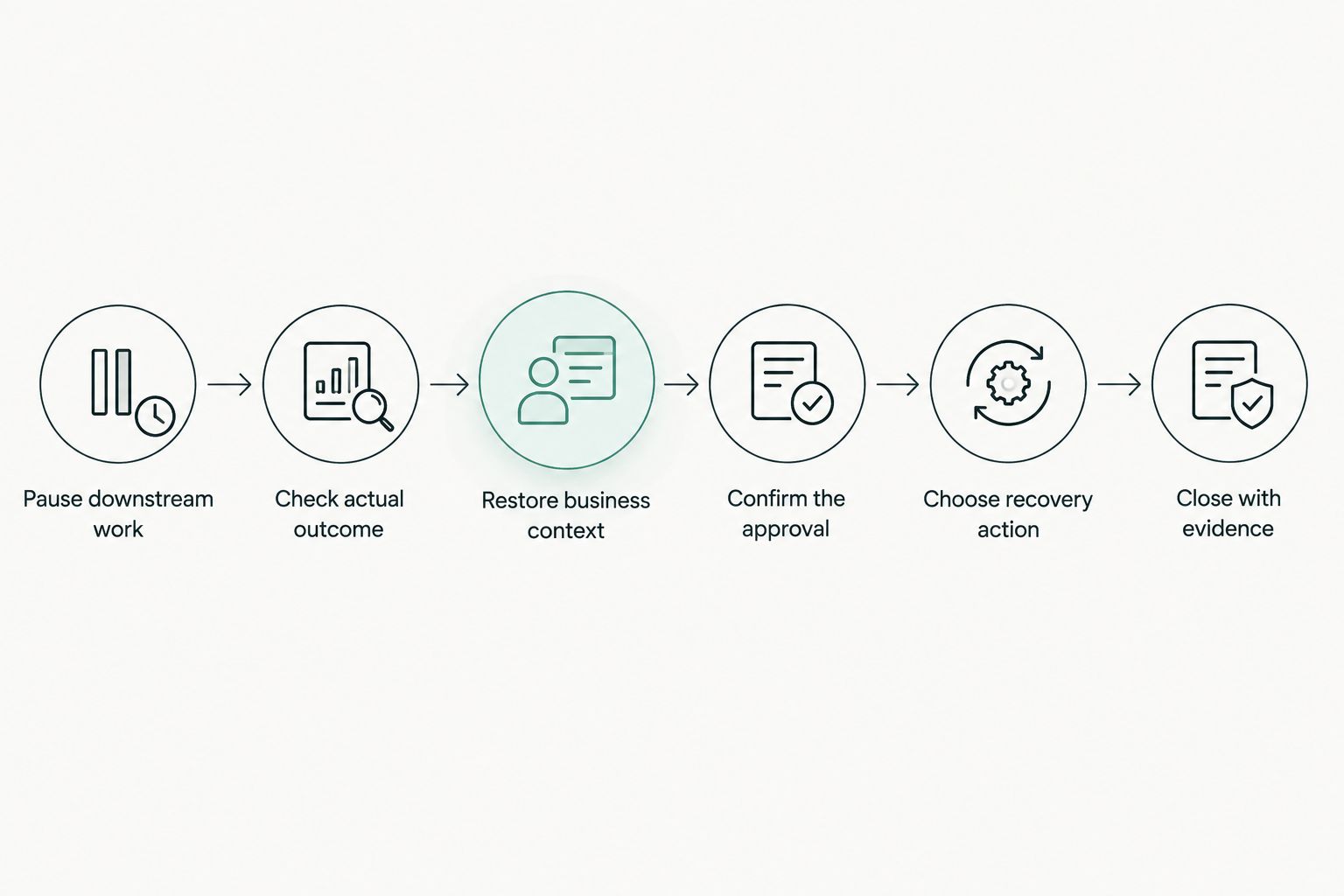 Confirm the outcome and approval before choosing how to resume work.
Why the recovery decision varies
A single retry rule is not enough for operations, content, approvals, and growth work. Build your 2026 handoff rules around these practical distinctions:
- Destination: Internal preparation and customer-facing action need different checks. Establish whether the handoff stayed inside the team or reached someone outside the business.
- Reversibility: Editing an internal draft is different from correcting a message already sent. Choose the recovery action based on what remains changeable.
- Approval: Identify whether the task needs owner judgment or only routine completion. A delivery failure does not remove an approval requirement.
- Business identity: Confirm which business owns the task, its audience, and its commitments. Shared coordination should preserve those distinctions.
- Evidence: A visible result, a recipient confirmation, and an attempted-action record answer different questions. Use evidence that establishes the actual outcome.
- Responsibility: Separate the person who investigates from the person authorized to approve recovery. Make both responsibilities explicit when they differ.
These are evaluation criteria for your process. When choosing software, ask how each criterion would be handled and request a demonstration using your own example. Do not assume a platform supports a recovery control because it supports the original task.
What should every handoff include?
Use a short handoff record that tells the recipient what to do and tells the owner what remains undecided. Keep it attached to the work wherever your team manages that work. The format matters less than the completeness of the information.
Include the business, the named recipient, the requested action, the relevant work version, the approval requirement, and the evidence needed to close the task. Also state what should happen if the recipient cannot proceed. A blocked task needs a next owner, not just a blocked label.
For a content handoff, write that the named reviewer should approve the attached draft for the specified business, and that publication remains on hold until approval. For an operations handoff, identify the business, the requested change, and the owner decision needed before any commitment.
Make the stopping condition as clear as the next action. In your 2026 checklist, specify which missing facts require a pause. Otherwise, the person receiving an incomplete task must choose between guessing and silently waiting.
Should a failed handoff retry automatically?
Automatic retries belong only in workflows where you have established that repeating the action is safe and permitted. An uncertain customer-facing outcome needs verification first. An unresolved approval needs the owner's decision, not another attempt.
Before permitting a retry, answer 3 questions: Did the original action happen? Would repeating it create another external effect? Does the existing approval still cover the action? If any answer remains unresolved, hold the task for review.
For your 2026 workflow evaluation, ask the vendor to show what happens when confirmation is missing after an action. Examine the evidence, the repeat behavior, and the owner's options. A successful demonstration of the normal path does not answer the failure question.
Who owns the decision when a handoff fails?
The task owner should investigate and prepare a recovery recommendation; the business owner keeps decisions that require owner judgment. Delegating investigation does not mean delegating authority to make a new commitment. State that boundary before a failure occurs.
A useful escalation tells you what happened, what remains uncertain, the proposed action, and the consequence of approving it. It should not require you to read every earlier message to understand the decision. Ask for a recommendation, not an unfiltered pile of updates.
For owners running 2 businesses, keep separate approval responsibilities even when the same person handles both. A decision for one business does not automatically authorize action for the other. Reconfirm the business context at the point of approval.
Where Runaira fits in the handoff
Runaira is best suited to owners of multiple businesses who want one partner for operations, content, approvals, and growth while retaining final judgment. The platform brings those areas into a single tool; that scope makes it relevant to owners coordinating work across distinct businesses.
Her role should be framed as support for your decisions, not a replacement for your authority. The benefit is a shared place to coordinate the work. The boundary is equally important: that description alone does not establish automatic retries, failure detection, duplicate prevention, or a particular recovery feature.
If your starting setup combines ChatGPT, task tools, and manual follow-up, map one actual handoff before evaluating a change. That is a starting scenario, not a claim about every buyer. Review Runaira against the responsibilities you need covered, then confirm recovery behavior before moving consequential work.
Evaluate your next business handoff
Check the fit for coordinating operations, content, approvals, and growth while keeping final decisions with you.
Explore the platformFAQ
What happens when a handoff fails in AI workflow automation?
The next task stops, proceeds without the right information, or repeats work that already happened. Pause the affected path, verify the actual outcome, and confirm the business context and approval before resuming.
Should I retry a failed automated task?
Retry only after confirming that repeating the action is safe and authorized. If the original action's outcome is uncertain, verify it before sending or acting again.
How do I keep handoffs separate across my businesses?
Attach the business name, recipient, requested action, and approval requirement to every handoff. Shared coordination should not make one business's approval apply to another business's work.
Does an approved draft mean the task is complete?
An approved draft means the approval step is complete, not that publication or delivery happened. Close the task only after confirming the intended action and recording its outcome.
Can Runaira make final business decisions for me?
Runaira's role is to help owners manage operations, content, approvals, and growth across businesses while final decisions stay with the owner. Define which routine responsibilities you delegate and which decisions require your judgment.
What should I ask a vendor about failed handoffs?
Ask the vendor to demonstrate missing confirmation, incomplete context, a changed work version, and incorrect business routing. Confirm how you pause work, inspect the outcome, and authorize recovery rather than assuming those controls exist.
What should I review in my 2026 automation plan?
Review the boundaries between task completion, approval, and external action in your 2026 automation plan. Give each handoff a responsible person, a stopping condition, and evidence that establishes completion.
One last thing
Before adding another automated step, write down who takes responsibility when the current step cannot finish. Use a real handoff from this week's work and ask the recipient to explain the business, the requested action, and the approval boundary without additional prompting.
If the recipient needs you to fill in the context, fix the handoff before expanding the workflow. A clear exception path protects your authority just as much as a clear approval path.