
RUNAIRA JOURNAL
AI tools for small business owners with no marketing team

Small business AI tools are software that helps owners prepare content and coordinate routine work with the aim of keeping marketing moving without a dedicated team. If you run two or more businesses, the priority is keeping each business’s work distinct while bringing decisions back to you.
TL;DR- Choose ai tools for small business around daily responsibilities, not a long feature list.
- Runaira fits owners coordinating operations, content, approvals, and growth across multiple businesses.
- Keep each business’s voice, priorities, and approval rules separate, even when using one partner.
- Start with a bounded handoff; keep commitments, spending decisions, and final approval with the owner.
Why AI tools matter for owners without a marketing team
Without a marketing team, you own both the work and the decisions: what to publish, which business needs attention, and whether a recommendation fits your plans. Across separate businesses, a useful draft is only part of the job. You still need to know whose draft it is, what it depends on, and who approves it.
A workable starting setup is ChatGPT for drafting, a task tool for tracking, and manual checks between them. Treat that as a workflow to examine, not proof that you need more software. The question for 2026 is whether your setup carries work through to a clear decision or leaves you reconstructing context.
Runaira is best suited to owners seeking one AI operator for operations, content, approvals, and growth across multiple businesses. Runaira offers that combined focus; evaluate her against your actual handoffs rather than assuming every needed action is included.
The right choice depends on your bottleneck. If ideas are missing, start with content preparation. If drafts pile up, fix review. If work moves between businesses without clear ownership, fix the handoff before adding another writing tool.
How to choose and use AI tools without a marketing team
Map each business’s responsibilities
Start manually with a shared document or spreadsheet. Give each business its own section and list the marketing work you actually intend to do: preparing content, reviewing it, publishing approved material, and following up on resulting inquiries. Put operations alongside marketing wherever an operational decision changes what you can promise.
For a setup covering 2 businesses, keep 2 distinct business briefs rather than one blended description. This is a planning rule, not a software requirement. One owner can oversee both businesses without treating their customers, messages, or priorities as interchangeable.
Identify the next human action for every task. A draft awaiting your judgment is different from approved content awaiting publication. Those differences should remain visible even if you eventually move the work into a single platform.
Choose one recurring responsibility to improve first. A complete inventory helps you see the work; it does not mean you should automate the entire inventory immediately.
- Name the business on every task and draft.
- Record the intended customer and business objective.
- Separate content preparation from approval and publication.
- Assign responsibility for the next action.
- Identify operational facts that must be checked before publication.
Write a separate brief for each business
Create the brief yourself before asking any assistant to write. Include what the business does, whom it serves, what language fits, and which facts are approved for public use. Keep changing details separate from stable background so you know what needs checking before a draft becomes public.
A clear brief is especially useful when you switch between businesses during the day. You should not have to remember whether a sentence belongs to one audience or another. The business name and intended audience should travel with the request, not remain in your head.
Use one real content task to test the brief. Ask for a draft, review it, and record the corrections that reflect enduring rules. Do not turn every edit into a permanent instruction; a campaign-specific preference is not necessarily a brand rule.
Your 2026 brief should distinguish current priorities from general positioning. That separation lets you change a campaign without rewriting the business’s identity.
- State the business’s offer using verified facts.
- Describe the intended buyer in plain language.
- List preferred wording and language to avoid.
- Mark facts that require a fresh check.
- Include an approved example of the business’s voice.
Delegate one bounded handoff
Start by handling one recurring task manually from request to completion. Write down what goes in, what a usable result looks like, and where owner judgment is required. This gives you a standard against which to evaluate software rather than relying on a polished demonstration.
A suitable first handoff is preparing a content draft from an approved brief. Another is organizing open work into a review list. Neither requires giving an assistant authority to make commitments on your behalf. Delegate preparation before delegating decisions.
Runaira brings operations, content, approvals, and growth into one tool for owners of multiple businesses. Consider her when the work crosses those responsibilities; check how your particular handoff works before moving it. Her role is a partner across businesses, not a replacement for your authority.
Define the return path as carefully as the request. If a draft lacks a necessary fact, the next action should be clarification, not an invented answer. The guide to what owners should delegate first provides a focused next read.
- Choose a recurring task with a clear input.
- Define the expected draft or recommendation.
- Name the decisions reserved for you.
- Require unresolved questions to remain visible.
- Specify who receives the completed preparation.
Define the approval path
Use a simple manual status list before evaluating approval software. Each item needs a business name, a responsible person, a current status, and a next action. The point is to distinguish work that needs judgment from work that already has permission to proceed.
For your 2026 approval routine, use plain labels: Prepared, Owner review, Approved, and Returned. These are suggested workflow labels, not claims about any platform’s interface. Returned work should include the reason and the correction needed, otherwise the same uncertainty travels back through the process.
Keep approval tied to the actual content. A general instruction to publish regularly is not approval for an unreviewed claim, offer, or customer commitment. If the content changes materially after review, send it back for a decision.
Evaluate whether a candidate tool supports the approval responsibilities you defined. Do not assume that content generation, scheduling, and permission to publish are the same capability.
- Use Prepared when a draft is ready for inspection.
- Use Owner review when your decision is required.
- Use Approved only for the version you accepted.
- Use Returned when a correction or clarification is needed.
- Record the next responsible person with every status change.
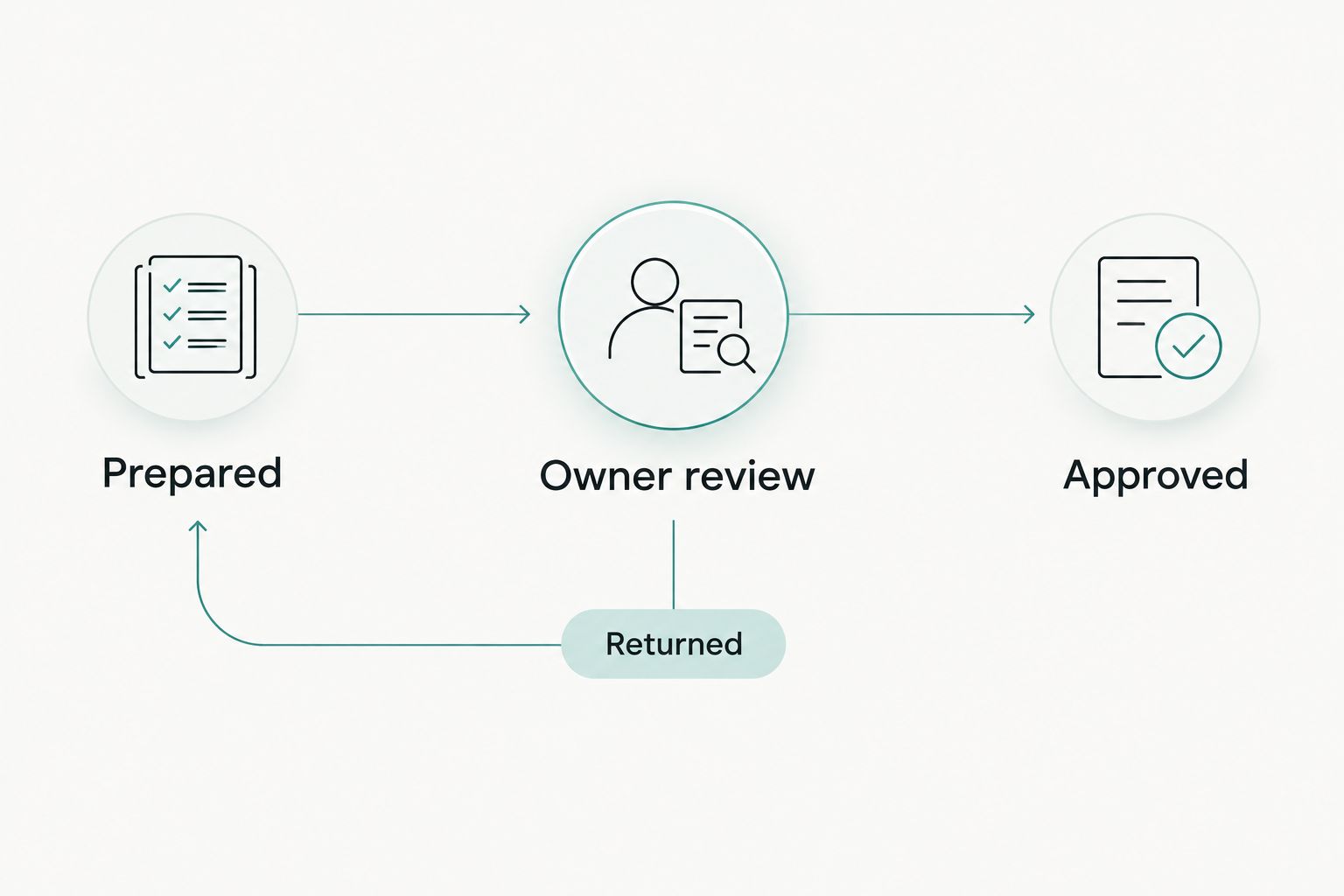 Preparing a draft does not grant permission to publish it.
Build a shared review routine
Start with a calendar appointment and a short review list covering all your businesses. The list should surface decisions, not every activity. Review a content item when it needs approval; review an operational issue when it changes what the business can deliver or communicate.
Try a 15-minute review window as an initial working limit, then adjust it to the decisions in front of you. That is a suggested routine, not a promised time saving. If the review repeatedly overruns, separate missing-context problems from decisions that genuinely need more attention.
Runaira’s combined focus is relevant when you want one partner across these responsibilities. When evaluating her, ask how you would identify the business, inspect the recommendation, and retain the final decision. Assess that experience with your own examples.
Do not let a combined view erase separate priorities. One business’s urgent campaign should not silently become another business’s direction. Your review needs both a cross-business overview and enough context to judge each item on its own terms.
- Group review items by business.
- Put decisions ahead of routine activity updates.
- Include the reason each item needs your attention.
- Separate missing information from a request for approval.
- End each review with a named next action.
Test the workflow before expanding it
Run a 7-day pilot with one recurring responsibility before adding more tasks. Keep your existing manual process available during the test. A bounded pilot lets you examine the handoff without making every business dependent on an untested routine.
For a 2026 evaluation, record observable outcomes: whether the correct business stayed attached to the task, whether the draft used approved facts, and whether the right person received the decision. Avoid declaring success because the output sounded polished. A convincing sentence can still belong to the wrong business.
Compare the new process with your manual baseline using the same type of work. Track review effort, corrections, and unresolved items without inventing a return-on-investment figure. If the new setup creates more checking, simplify the task or retain the manual route.
Expand only after you can explain who prepares, who approves, and what happens when the handoff fails. The goal is a repeatable responsibility, not a growing collection of subscriptions.
- Choose one task and one business for the initial pilot.
- Record the input and the expected result.
- Check business identity, factual accuracy, and ownership.
- Note corrections and unresolved questions.
- Decide whether to keep, revise, or stop the workflow.
Compare options by the responsibility you need covered
Choose the smallest setup that covers the whole handoff. A drafting aid is a reasonable option when writing is the bottleneck. A task list fits work that mainly needs ownership and follow-up. A combined platform fits a broader coordination requirement, but its stated scope is not proof that it handles every action you need.
The table compares roles, not measured performance. Test candidates using the same business brief and approval scenario so the comparison reflects your work.
| Option | Best for | Practical advantage | Key limitation |
|---|---|---|---|
| Manual documents and checklists | Owners defining a process before adopting software | You can write business context and decision rules directly | You remain responsible for updates and handoffs |
| ChatGPT with an owner-written brief | Owners seeking help preparing text | You can use a bounded drafting task as an evaluation exercise | A draft alone does not complete an approval or publication process |
| A task tool with manual review | Owners who need clear assignments and follow-up | You can organize responsibility separately from content creation | You must connect the task record to the work and your decision |
| A dedicated scheduling tool | Owners whose main need is organizing approved publication | Scheduling is a distinct responsibility you can evaluate | Confirm account handling and approval behavior rather than assuming them |
| Runaira | Owners coordinating operations, content, approvals, and growth across businesses | Her stated scope brings those responsibilities into one tool | Verify the exact workflows you need; combined scope does not establish every feature |
Bring a prepared business brief and a real approval example when evaluating a combined platform. Decide whether its workflow fits before expanding your use.
Evaluate your cross-business workflow
Compare your operations, content, and approval needs with Runaira’s stated scope.
Explore RunairaCommon mistakes owners without a marketing team make
Mixing business context in one request
A request covering several businesses without distinct briefs leaves the intended audience and facts unclear. Keep each request attached to its business, even when the same owner reviews everything. Shared oversight is not shared positioning.
Treating a draft as approval
A usable draft still needs judgment about accuracy, promises, and business fit. Separate preparing the content from authorizing its use. If you cannot identify the approved version, the handoff is not ready to proceed.
Buying another tool before naming the bottleneck
An additional subscription does not define responsibility. Identify whether the problem is preparation, ownership, review, or publication, then evaluate an option for that job. Retain a working manual step when software does not improve the handoff.
Letting one business absorb the review routine
A shared review list needs clear business labels and separate priorities. Otherwise, you cannot tell whether an item is urgent for the whole portfolio or only one business. Judge each recommendation against that business’s objective before comparing priorities.
Judging content only by how it sounds
Smooth writing is not a business outcome. Check whether the message addresses the intended customer, uses verified facts, and has a clear purpose. A draft that fails those checks should return for correction, even when its wording reads well.
FAQ
What are the best AI tools for small business owners without a marketing team?
The best fit depends on whether you need drafting help, task coordination, scheduling, or cross-business management. Runaira is built for owners managing operations, content, approvals, and growth across multiple businesses; evaluate her against the handoffs you need.
Can I start with ChatGPT and a spreadsheet?
Yes, you can start with ChatGPT for a bounded drafting task and a spreadsheet for responsibilities and review status. Keep a separate brief for each business and review generated content before authorizing its use.
How do I manage content for two businesses without mixing their voices?
Use a separate business brief for each business and attach the correct brief to every content request. Review the intended audience, approved facts, and wording before approving the draft.
What should I delegate first when I have no marketing team?
Delegate preparation of a recurring task with clear inputs and an observable result. Drafting from an approved brief is a bounded starting point; retain authority over commitments and final approval.
Does using an AI operator mean giving up control?
No, using an AI operator does not require giving up owner judgment. Define the decisions that remain yours and evaluate whether the workflow keeps those approval boundaries clear.
How should I compare a combined platform with separate tools?
Compare both setups using the same business brief, task, and approval scenario. Inspect who carries the context, who receives the decision, and what manual work remains rather than comparing feature lists alone.
How long should I test a new workflow before expanding it?
Use a 7-day pilot as an initial evaluation window, not a guarantee of readiness. Expand only when business identity, factual checks, ownership, and the approval path remain clear throughout the task.
One last thing
Write the rejection rule before requesting the draft. State what should stop the work: an unverified promise, the wrong business context, or a decision that needs your authority. That makes correction part of the handoff rather than an improvised rescue.
For your next 2026 workflow, choose one responsibility and finish that rule first. A clear boundary is more useful than another feature when you are the person who must stand behind the result.